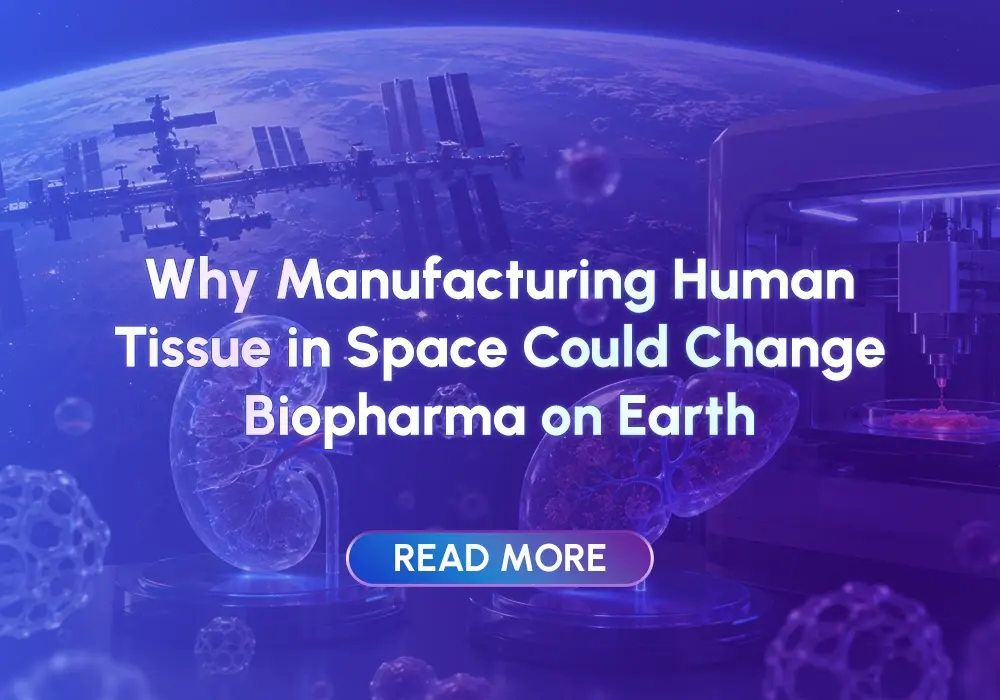
Why Manufacturing Human Tissue in Space Could Change Biopharma on Earth
For centuries, manufacturing has been defined by our ability to control the environment. Whether producing steel, semiconductors or biologic medicines, every technological leap has come from understanding the conditions that allow a product to be made more reliably, more efficiently and at a higher quality. Modern biopharmaceutical manufacturing is no different. Cleanrooms, sterile processing, precise temperature control and tightly regulated production systems exist because biology is extraordinarily sensitive to its surroundings.
One variable, however, has always been beyond our control.
Gravity.
It is so constant that we rarely consider its influence, yet it shapes almost every stage of biological development. In tissue engineering, gravity is not simply a law of physics—it is an engineering challenge that researchers have spent decades learning to work around.
That challenge has now inspired one of the most intriguing manufacturing experiments in regenerative medicine.
Researchers from Auxilium Biotechnologies have successfully bioprinted living kidney and liver tissue aboard the International Space Station (ISS), marking the first time these tissue constructs have been engineered in microgravity before being safely returned to Earth for scientific analysis. While the achievement naturally captures attention because it happened in space, its real significance lies much closer to home. Rather than proving that tissues should one day be manufactured in orbit, the mission is designed to answer a far more important question: how does living tissue behave when gravity is no longer shaping its development?
The answer could influence how future therapies are designed, tested and manufactured here on Earth.
Why Gravity Matters More Than We Think
Unlike conventional pharmaceuticals, living tissues are not static products. They are dynamic biological systems that continue developing long after the printing process has finished. Cells divide, migrate, communicate with neighbouring cells and gradually organise themselves into complex three-dimensional structures that determine how the tissue ultimately functions.
This remarkable process is also remarkably fragile.
As tissues grow larger, gravity continuously pulls on them. Soft biological structures can sag or deform under their own weight before they have matured sufficiently to support themselves. To compensate, researchers often rely on specialised scaffolds and bioinks that provide temporary structural support while tissues develop. These technologies have transformed the field of bioprinting, but they also introduce additional materials and manufacturing steps that can influence how cells behave.
For years, much of the innovation in regenerative medicine has focused on improving these tools. Better printers. Better biomaterials. Better scaffold designs. Better manufacturing workflows.
The ISS mission approaches the challenge from an entirely different direction.
Instead of asking how engineers can better compensate for gravity, it asks what happens when gravity itself is largely removed from the equation.
Microgravity creates an environment unlike anything that can be reproduced consistently on Earth. Without the constant downward force acting on developing tissue, cells are free to organise themselves in three dimensions with far fewer physical constraints. Scientists believe this may allow biological structures to mature in ways that more closely resemble natural human tissue, while also revealing behaviours that would otherwise remain hidden under Earth's gravitational conditions.
Whether those advantages translate into measurable biological improvements is precisely what researchers are now investigating.
More Than a Space Experiment
At first glance, the story is easy to dismiss as another example of scientific curiosity in orbit. Space has long been a testing ground for experiments that would be difficult—or impossible—to perform on Earth, and headlines about manufacturing in microgravity have become increasingly common.
This mission is different because it addresses one of regenerative medicine's most fundamental bottlenecks.
Engineering living tissue has never been solely about printing cells into a desired shape. The greater challenge lies in ensuring those cells organise themselves into functional tissue that accurately replicates the structure and behaviour of the human body. Every improvement in that process has implications that extend well beyond tissue engineering itself.
Higher-quality tissue models can improve drug discovery by providing researchers with laboratory systems that more accurately predict how medicines will perform in humans. They can strengthen disease modelling, enabling scientists to study complex biological conditions in ways that conventional cell cultures cannot replicate. They also have the potential to improve toxicity testing, reducing reliance on less representative experimental models during early-stage pharmaceutical development.
These applications are already transforming biomedical research.
The question now is whether manufacturing conditions can elevate them even further.
A New Perspective on Biomanufacturing
For the pharmaceutical industry, manufacturing has traditionally been viewed as the final stage of innovation—the point at which scientific discoveries are translated into products that can be produced safely and consistently at scale.
Regenerative medicine challenges that way of thinking.
Here, manufacturing is not simply about efficiency or scalability. It is part of the science itself. The conditions under which tissues are produced directly influence how those tissues develop, function and ultimately perform.
That is why the ISS experiment resonates far beyond the field of space research.
If scientists discover that microgravity enables more natural tissue organisation or reduces the need for artificial structural support, those findings may inspire entirely new manufacturing approaches on Earth. Future bioprinters, scaffold materials and tissue maturation systems could all evolve based on principles first observed hundreds of kilometres above the planet.
The commercial future of tissue engineering is unlikely to depend on routine manufacturing in orbit.
Its future may instead depend on applying lessons learned in orbit to improve manufacturing on Earth.
That distinction is what makes this mission so compelling. It shifts the conversation away from the novelty of space exploration and towards a much broader question about how biological products should be manufactured in the decades ahead.
What the Mission Has and Hasn't Proven
As exciting as the achievement is, it is equally important to understand what it represents—and what it does not.
The ISS mission has demonstrated that living kidney and liver tissue constructs can be successfully bioprinted in microgravity, maintained throughout their time in orbit and safely returned to Earth for further evaluation. Researchers are now analysing the tissues to determine whether they exhibit meaningful differences in architecture, cellular viability and biological function compared with tissues produced under Earth's gravitational conditions.
Those findings will ultimately determine the mission's long-term significance.
What the experiment has not demonstrated is the ability to manufacture transplant-ready human organs in space, nor does it suggest that commercial pharmaceutical production is about to move beyond Earth's atmosphere. Space-based manufacturing remains extraordinarily expensive and logistically complex, making it impractical for routine production.
Instead, the value of this mission lies in the knowledge it generates.
Throughout the history of science, some of the most important experiments have not been those that produced an immediate commercial application, but those that fundamentally changed how researchers understood a problem. This mission has the potential to do exactly that by revealing how gravity influences tissue formation in ways that simply cannot be replicated inside a terrestrial laboratory.
Even if every future therapy is manufactured on Earth, the manufacturing principles behind those therapies could be shaped by discoveries made in microgravity.
A Turning Point for Regenerative Medicine
Regenerative medicine has made remarkable progress over the past two decades. Advances in stem cell biology, biomaterials, bioprinting and tissue engineering have steadily brought the field closer to clinical reality. Yet one challenge continues to define its future: producing living tissues that are not only biologically functional, but also consistent, reproducible and scalable.
That is where manufacturing becomes just as important as biology.
Every innovation that improves tissue organisation, reduces variability or enables more predictable development strengthens the entire regenerative medicine ecosystem. Better tissue models improve preclinical research. More physiologically relevant constructs enhance drug discovery and toxicity testing. More reliable manufacturing processes bring future cell and tissue-based therapies one step closer to widespread clinical adoption.
Seen through that lens, the ISS mission is less about space exploration and more about expanding the scientific toolkit available to tissue engineers.
It demonstrates that manufacturing environments themselves can become variables worth investigating—not merely conditions to be controlled, but opportunities for discovery.
That shift in thinking could influence how the next generation of biomanufacturing facilities, bioprinters and tissue maturation systems are designed.
Looking Beyond the Headlines
Scientific breakthroughs often attract attention because of where they happen or the technology involved. The first reaction to this story is understandably one of fascination: scientists have successfully bioprinted living human tissue aboard the International Space Station.
The more important story emerges after the headline.
This mission challenges a long-held assumption in tissue engineering—that gravity is simply another constraint engineers must design around. By removing that constraint, researchers now have an opportunity to observe biological processes from an entirely new perspective and ask questions that were previously impossible to investigate.
Whether those insights ultimately reshape regenerative medicine will depend on years of further research.
But every transformative field has defining moments when a new way of thinking begins to emerge.
This may prove to be one of them.
The Bigger Picture
For more than a century, manufacturing has largely been about building better machines. Every generation has produced more precise equipment, more sophisticated automation and increasingly controlled production environments.
This experiment hints at a different possibility.
Perhaps the next breakthrough in regenerative medicine will come not from improving the printer, but from understanding the environment in which biology chooses to build itself.
If that proves true, the first tissue engineered in space will be remembered not as the beginning of orbital manufacturing, but as the moment we learned how to manufacture better on Earth.
Download the Full White Paper Here!
Download the Full e-Book Here!
DownloadDownload the Full Interview Here!
DownloadSubscribe For News Updates
Subscribe to the IMAPAC Insights to stay informed of the latest news in the biopharmaceutical industry.